
SEG Dynamics 2.0 with Smart Light Barrier
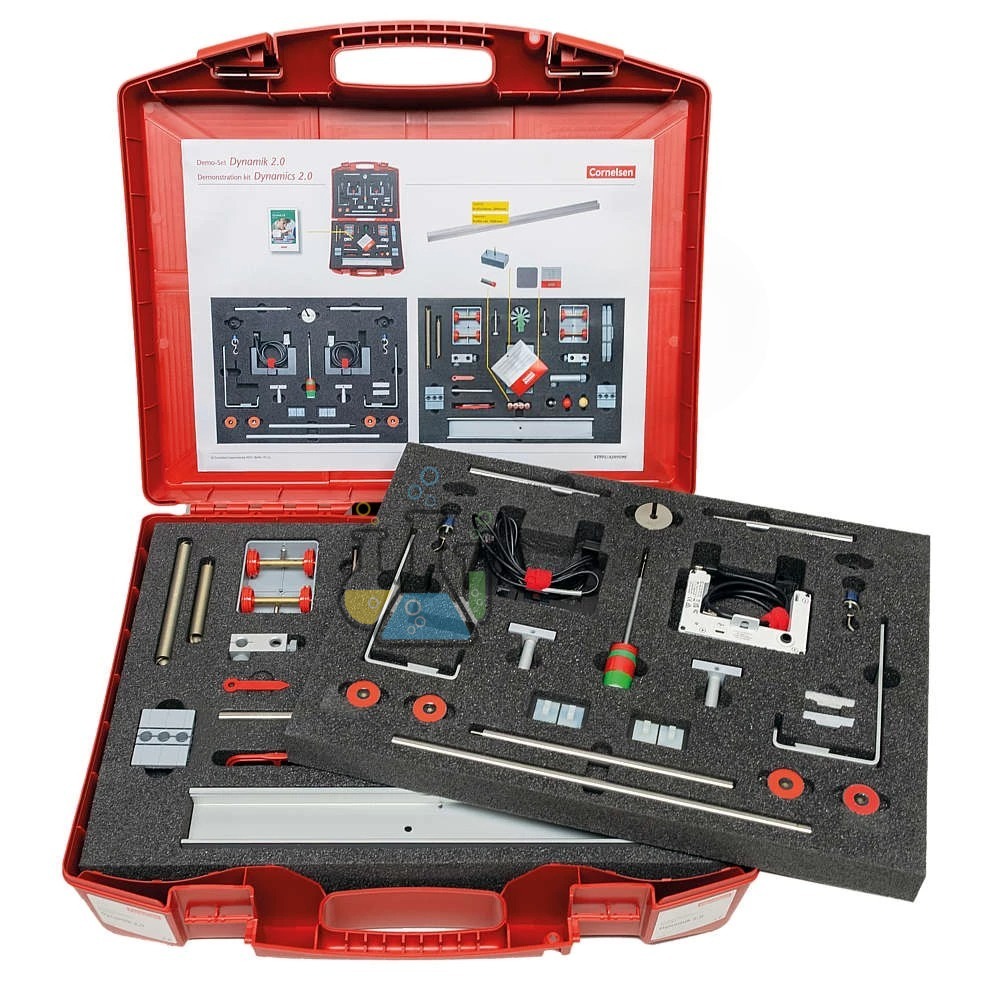
Product Code : SCL-EI-10597
Quick answer: SEG Dynamics 2.0 with Smart Light Barrier gives students a digital way to measure velocity, acceleration, free fall, pendulum motion and collisions. The Smart Light Barrier uses two infrared beams spaced 1.5cm apart with 0.1ms time resolution, connecting to a phone, tablet or computer over Bluetooth 4.0 or USB, and is used with a 1m track and scale for accurate linear-motion experiments.
| Specification | Detail |
|---|---|
| Product | SEG Dynamics 2.0 with Smart Light Barrier |
| Intended Users | School physics students, science teachers, STEM labs, mechanics practical groups |
| Set Dimensions | 540 x 450 x 150mm |
| Set Weight | 5kg |
| Smart Light Barrier Beam Spacing | 1.5cm |
| Time Resolution | 0.1ms |
| Connectivity | Bluetooth 4.0 or USB |
| Sensor Power Supply | Integrated rechargeable lithium-polymer battery, USB charging |
Key Features
- Digital dynamics experiment set for school mechanics lessons
- Smart Light Barrier uses two infrared beams spaced 1.5cm apart
- Supports velocity measurement with a single smart photogate sensor
- Bluetooth 4.0 and USB connectivity support modern classroom data collection
- 0.1ms time resolution supports precise short-time measurements
- Includes motion-analysis activities for Newton's laws, free fall and collisions
- 1m track with scale supports accurate linear-motion experiments
What's Included in the Kit
- SEG Dynamics 2.0 student experiment materials
- Smart Light Barrier
- USB charging cable for the Smart Light Barrier
- Operating instructions for the Smart Light Barrier
- 1m track with scale
- Spoke wheel for motion measurements
- Bag for fall experiments
- Teacher handout and student worksheets
- Detailed setup instructions and experiment guidance
- Example evaluations as copy templates or download material
- QR-code based support materials for differentiation
- Stackable storage tray with lid and storage layout plan
- Final itemized packing list
Applications / Uses
- Measuring velocity and acceleration in linear motion
- Creating motion diagrams from experimental data
- Investigating uniformly accelerated motion
- Studying Newton's laws through measured motion behaviour
- Measuring free-fall motion with small masses
- Investigating horizontal projectile motion
- Studying simple pendulum and spring pendulum motion
- Comparing elastic and inelastic collisions
How to Use the SEG Dynamics 2.0 with Smart Light Barrier
- Select the dynamics experiment from the teacher guide or worksheet
- Place the track, spoke wheel, Smart Light Barrier and required motion parts on a stable bench
- Connect the Smart Light Barrier to a tablet, smartphone or computer using Bluetooth or USB
- Align the moving object so it passes through the light barrier correctly
- Start the measurement and release the object according to the setup instructions
- Record time, velocity or acceleration values and compare them with expected motion laws
- Switch off or disconnect the sensor before changing the experiment arrangement
Safety note: Use the set under teacher supervision. Secure the track before experiments, keep hands clear of moving parts or falling objects, and handle rechargeable sensor equipment according to the operating instructions.
Care & Maintenance
- Store the Smart Light Barrier in its assigned compartment after use
- Recharge the sensor with the supplied USB cable when required
- Keep the track, spoke wheel and optical openings clean and free from dust
- Do not drop the sensor or expose it to moisture, impact or excessive heat
Pairing with Other Mechanics Apparatus
The SEG Dynamics 2.0 Kit adds digital measurement to a broader mechanics teaching programme. It pairs naturally with the Class Set Mechanics 2.0 for a full multi-topic mechanics curriculum, the Mechanics of Solids Kit for single-group statics and dynamics work, and the Flex Box Physics Kit for additional structural-mechanics experiments.
Frequently Asked Questions
What is the SEG Dynamics 2.0 Kit used for?
The SEG Dynamics 2.0 Kit is used to measure and analyse motion, velocity, acceleration, free fall, Newton's laws, pendulum motion and collisions in school physics labs.
What does the Smart Light Barrier measure?
The Smart Light Barrier measures time-based motion events and can determine velocity using two infrared beams spaced 1.5cm apart.
Can the Smart Light Barrier connect wirelessly?
Yes. The verified sensor specification lists Bluetooth 4.0 connectivity, and it can also connect by USB.
Does the kit support collision experiments?
Yes. The confirmed experiment topics include momentum conservation, elastic collisions and inelastic collisions.
What is the size of the SEG Dynamics 2.0 set?
The verified source lists dimensions of 540 x 450 x 150mm and a weight of 5kg.
Related Products
Request a Quote
For digital motion experiments, Newton's laws practicals and school mechanics procurement, request a quotation through our Contact Us page, or submit institutional and tender requirements via our Tenders page.
Last updated: September 2026
.png)
 (1).png)
.jpg)
 (1).png)
-Photoroom (1).png)
 (1).png)
.jpg)
.png)