
Hall effect measuring device
 (1).png)
Product Code : SCL-EI-10714
Quick answer: The Hall Effect Measuring Device is a physics laboratory instrument used to measure Hall voltage and study charge-carrier type, Hall coefficient, mobility, conductivity and carrier concentration in a current-carrying sample placed in a perpendicular magnetic field.
Technical Specifications
| Specification | Detail |
|---|---|
| Product Name | Hall Effect Measuring Device |
| Product Category | Physics Lab Equipment / Hall Effect Measurement Apparatus |
| Intended Users | Colleges, universities, physics teachers, semiconductor labs, STEM labs, laboratory technicians, and educational procurement teams |
| Main Concepts | Hall voltage, Hall coefficient, carrier type, mobility, conductivity, carrier concentration, and magnetic induction |
| Capacity | Not applicable; this is a measuring instrument, not a container |
Key Features
- Hall voltage measurement: measures, or supports measurement of, transverse voltage across a sample in a magnetic field.
- Semiconductor physics teaching aid: helps demonstrate carrier type, carrier concentration, mobility, and conductivity.
- Magnetic-field study support: works with Hall probes, samples, magnets, and varying field strength.
- Compatible with lab setups: pairs with suitable electronic instruments, power supplies, meters, and sample holders.
- Supports advanced practicals: suited to college, university, and advanced school physics laboratories.
- Reusable measuring device: designed for repeated experiments when used within confirmed ratings.
- Safety-focused operation: intended for controlled current, voltage, temperature, and magnetic-field conditions.
What's Included in the Kit
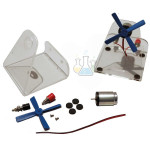
- 1 × Hall effect measuring device main unit
- Hall probe, sample holder, or sample board
- Connection leads, terminals, or probe cables
- Magnet assembly or magnetic-field source
- Instruction sheet, experiment guide, or calibration document
Applications / Uses
- Measuring Hall voltage in semiconductor or metal samples.
- Determining charge-carrier type from Hall-effect measurements.
- Studying Hall coefficient, mobility, conductivity, and carrier concentration.
- Observing how magnetic field and current affect measured Hall voltage.
- Using with compatible meters, magnets, power supplies, and general lab equipment.
- Supporting solid-state physics, electromagnetism, and semiconductor practicals.
How to Use the Hall Effect Measuring Device
- Place the measuring device on a clean, dry, stable laboratory bench.
- Mount the Hall sample or Hall probe in the compatible holder.
- Position the sample correctly in the magnetic-field gap according to the experiment guide.
- Connect the current supply, Hall voltage terminals, and measuring leads as instructed.
- Apply only the confirmed current, voltage, and magnetic-field settings.
- Record Hall voltage readings and use confirmed sample geometry to calculate Hall coefficient or mobility.
- Switch off the instrument before changing samples, leads, or field settings.
Safety note: Do not exceed the confirmed current, voltage, temperature, or magnetic-field rating of the device or sample. Avoid short circuits, exposed terminals, overheating, and damaged leads, and use suitable safety protective wear during broader electrical laboratory demonstrations.
Care & Maintenance
- Store the device and accessories in a dry, dust-free cabinet after use.
- Keep terminals, probes, sample holders, and cables clean and free from corrosion.
- Do not bend Hall probes, scratch semiconductor samples, or force connectors.
- Replace damaged leads, loose terminals, or cracked sample holders before reuse.
Completing a Hall Effect Teaching Set Across Materials
The Hall Effect Measuring Device is the general-purpose instrument in Lab Glassware Manufacturer's Hall-effect range, and it works alongside the material-specific accessories in the same group. The Hall effect universal holder mounts different sample types for use with this device, while the Hall effect zinc test and Hall effect Ge p-doped sample provide ready metallic and semiconductor test pieces so students can compare Hall behaviour across conductor types on the same measuring setup. Confirm sample and holder compatibility with Lab Glassware Manufacturer before combining items into one order.
Frequently Asked Questions
What is a Hall effect measuring device used for?
It measures Hall voltage and helps study charge-carrier type, Hall coefficient, mobility, conductivity, and carrier concentration in a sample.
Is this device suitable for school physics labs?
It is suitable for supervised college, university, and advanced school physics laboratories because Hall measurements require controlled current, magnetic field, and sensitive voltage measurement.
Does the device need a magnetic field source?
Yes, Hall-effect experiments require a magnetic field source. Confirm whether magnets, an electromagnet, or a field unit are included with the supplied model.
Related Products
Request a Quote
For institutional or bulk pricing on the Hall Effect Measuring Device, please contact us or submit your requirement through our tender enquiry page.
Last updated: September 2026
.jpg)
.jpg)
 (1).jpg)
.jpg)
.jpg)
.jpg)
.png)