
Motor Generator Pair Base
-Photoroom (1).png)
Product Code : SCL-EI-10655
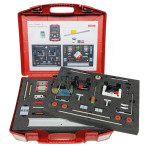
The Motor Generator Pair Base from Lab Glassware Manufacturer is a physics and electronics laboratory apparatus used to demonstrate conversion between electrical energy, mechanical rotation, and generated electrical output.
Quick answer: The Motor Generator Pair Base is a base-mounted apparatus pairing a motor and a generator so students can directly compare electrical-to-mechanical energy conversion (motor action) with mechanical-to-electrical conversion (generator action). The exact motor type, generator type, coupling method, and voltage/current ratings vary by model — check the specific listing before ordering.
Technical Specifications
| Specification | Detail |
|---|---|
| Product Name | Motor Generator Pair Base |
| Brand | Lab Glassware Manufacturer |
| Product Category | Physics Lab Equipment / Electronic Instruments / Electrical Machines Apparatus |
- Motor-generator pair format for direct comparison between input power and generated output.
- Base-mounted apparatus for stable bench-top classroom use.
- Physics and electronics use for lessons on electromagnetism, induction, motors, and generators.
- Compatible with meters and loads such as voltmeters, ammeters, lamps, and resistors where ratings match.
- Specification-dependent safety — current, speed, terminals, and coupling details are confirmed at order stage.
What Is Included
Motor Generator Pair Base with motor unit, generator unit, base, coupling, terminals, and leads. An activity sheet, storage box, or certificate may be included depending on the configuration ordered — confirm exact contents with Lab Glassware Manufacturer before ordering.
Applications / Uses
- Demonstrating electrical-to-mechanical energy conversion
- Showing generator output from mechanical rotation
- Teaching motor action, generator action, and electromagnetic induction
- Observing voltage output changes with rotation speed where suitable
- Using with voltmeters, ammeters, lamps, and low-voltage circuit boards
- Supporting STEM and school physics experiments on electrical machines
How to Use the Motor Generator Pair Base
- Confirm the voltage rating, current rating, coupling method, and terminal layout before use.
- Place the apparatus on a stable, dry laboratory bench.
- Inspect the motor, generator, base, coupling, wires, and terminals for damage.
- Connect the motor to a suitable low-voltage supply according to the experiment diagram.
- Connect the generator output to a voltmeter, lamp, or approved load.
- Switch on the supply and observe motor rotation and generated output.
- Vary the input voltage only within the confirmed safe range and record changes in output.
- Switch off the supply before changing connections or touching moving parts.
Safety note: Use only with low-voltage educational supplies unless the product is specifically rated otherwise. Keep fingers, loose clothing, wires, and hair away from rotating couplings, belts, shafts, and pulleys. Do not overload the motor or short the generator output.
Care & Maintenance
- Store the apparatus dry and protected from dust, impact, and chemical vapours.
- Keep terminals clean and tighten loose connections before classroom use.
- Check couplings, belts, pulleys, shafts, and mounting screws regularly.
- Remove from use if overheating, burning smell, unstable output, cracked insulation, or excessive vibration occurs.
Motor-Driven vs Hand-Cranked Generator Demonstrations
Lab Glassware Manufacturer offers more than one way to teach generator principles, and the choice depends on the energy source used to drive rotation. The Motor Generator Pair Base pairs an electric motor with a generator so a low-voltage electrical supply drives the rotation, letting students observe a complete electrical-to-mechanical-to-electrical energy chain in one apparatus. The Generator Hand 12V and Hand-Operated Generator Dynamot are driven by manual hand-cranking instead, which better suits lessons focused purely on mechanical-to-electrical conversion and manual energy input. Labs teaching the full motor-generator energy cycle typically choose the motor-driven pair base, while labs focused on manual generation choose a hand-cranked generator.
Frequently Asked Questions
What is a Motor Generator Pair Base used for?
A Motor Generator Pair Base is used to demonstrate how a motor converts electrical energy into rotation and how a generator converts rotation into electrical output.
What type of motor is supplied?
The motor type varies by unit — check DC motor, AC motor, or other motor details from the supplied product specification before ordering.
What voltage rating does it require?
The voltage rating varies by unit — check input and output ratings from the product label, datasheet, or supplier before ordering.
Can it be used with voltmeters and ammeters?
Yes. It can be used with suitable meters when the expected voltage and current remain within the confirmed meter and apparatus ratings.
Does it include connecting leads?
Connecting lead inclusion varies by unit — check which leads, meters, lamps, or loads are supplied with the final kit before ordering.
Is it suitable for school physics labs?
Yes. It is suitable for supervised school and college experiments on motors, generators, and electromagnetism.
Related Products
Request a Quote
For pricing, bulk institutional orders, or tender submissions, please contact Lab Glassware Manufacturer or visit our lab tender page.
Last updated: September 2026
.jpg)
-Photoroom (1).png)
.jpg)
 (1).png)
.png)
.jpg)
 (1).png)