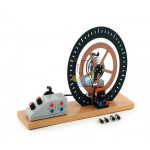
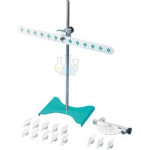
Load Cells with Amplifier 4 pcs
.jpg)
Product Code : SCL-PLE-10491
The Load Cells with Amplifier (4 pcs) from Lab Glassware Manufacturer is a physics and engineering laboratory sensor set used for measuring force, weight, tension, and compression through electrical signal output. Manufactured and exported from Ambala, Haryana, India since 1982, Lab Glassware Manufacturer supplies this load cell sensor set to school, college, and engineering laboratories in India and to institutional buyers in Ethiopia, Kenya, Somalia, and Djibouti as part of ongoing supply to the Horn of Africa region.
Quick answer: This set of 4 load cells with amplifier converts applied force, weight, or tension into an electrical signal that can be read by a data logger, meter, or computer interface, for use in force-measurement, strain, and mechanics experiments. It is supplied as a standard physics/engineering lab sensor set by Lab Glassware Manufacturer; no independent certification is claimed unless separately confirmed in writing.
| Specification | Detail |
| Product Name | Load Cells with Amplifier (4 pcs) |
| Brand | Lab Glassware Manufacturer |
| Category | Physics Lab Equipment > Force Measurement Sensors > Load Cell Experiment Accessories |
| Quantity | 4 load cells with amplifier |
| Included Components | 4 load cells, amplifier module, connection leads, mounting accessories, and guide sheet; exact bundle to be confirmed at time of order |
| Standards / Certifications | No certification claimed; add only if verified by datasheet, calibration certificate, or inspection report |
| Intended Users | Schools, colleges, physics and engineering laboratories, STEM labs, laboratory technicians, distributors, and institutional buyers |
| Indicative Price (India) | Request current indicative market benchmark, incl. GST, for the specific quantity and grade required |
Using Load Cells in Force and Mechanics Experiments
Each load cell in this set produces a small, load-proportional electrical signal that the accompanying amplifier module boosts to a usable output level for a meter, data logger, or computer interface. In a typical physics or engineering practical, load cells are mounted in tension, compression, or bending configurations to record force during a spring-extension study, a materials-strength test, or a dynamics experiment such as those run with the Basic Device Hooke's Law apparatus. Because output scaling and connector types can differ between amplifier revisions, institutions should confirm the exact interface (analogue voltage, current loop, or digital output) needed to match their existing data-logging equipment before ordering.
Frequently Asked Questions
What do these load cells measure?
They measure applied force, weight, tension, or compression and convert it into an electrical signal that can be read by a meter, data logger, or computer.
How many load cells are included in this set?
This set includes 4 load cells together with an amplifier module, connection leads, and mounting accessories; the exact bundle should be confirmed at the time of order.
Is this load cell set independently certified?
No certification is claimed for this set. Any calibration certificate, inspection report, or compliance document should be verified directly with Lab Glassware Manufacturer before being relied on.
Can Lab Glassware Manufacturer supply this for export or bulk institutional orders?
Yes. Lab Glassware Manufacturer manufactures and exports physics and engineering lab sensors from Ambala, Haryana, and can quote indicative FOB/CIF pricing for institutional and export orders on request.
Related Products
Basic Device Hooke's Law — a force-and-extension apparatus that can be paired with load cell sensing.
Precision Weight 5 g — a known-mass reference weight useful for verifying load cell readings.
Smart Timer — a compatible data-capture accessory for combined force/motion experiments.
Request a Quote
For indicative pricing, export documentation, or tender-compliant quotations for the Load Cells with Amplifier (4 pcs), contact Lab Glassware Manufacturer via the Contact Us page or submit requirements through the Lab Tender page.
Last updated: September 2026
.jpg)
 (1).png)
 (1).jpg)
.jpg)
 (1).jpg)
 (1).png)